Quick answer
Glucomannan is a natural water-soluble fiber from the konjac root. Taken with a full glass of water before a meal, it absorbs many times its weight in water and forms a thick gel that expands in your stomach, which supports a feeling of fullness and helps with appetite control. It works through a physical mechanism, not a stimulant, so it is caffeine-free.
Key takeaways
- Glucomannan is a water-soluble konjac fiber that swells into a gel in the stomach, supporting fullness through physical volume rather than stimulation.
- It is caffeine-free, so it suits people who are caffeine-sensitive or eat later in the day.
- Take each capsule with at least 8 oz of water, ideally 30 to 60 minutes before a meal, and never right before lying down.
- PhenAprin XR provides 800 mg per 2-capsule serving, a supportive amount that is honestly below the 3 g/day used in the EU authorized weight-management claim.
- Benefits build with consistent daily use alongside a calorie-conscious diet.
What is glucomannan?
Glucomannan is a water-soluble dietary fiber from the root of the konjac plant (Amorphophallus konjac), native to Southeast Asia. Among common dietary fibers it has one of the highest water-holding capacities known: it can absorb up to roughly 100 times its weight in water and form a viscous gel. That water-binding property is the whole basis of how it supports appetite control.
How does glucomannan support fullness?
It works mechanically. When you take glucomannan with water, it hydrates and expands in the stomach into a thick gel. That physical volume gently stretches the stomach, which sends normal fullness signals along the vagus nerve to the brain's appetite centers. It also slows how quickly the stomach empties, so the feeling of fullness lasts longer after a meal. Nothing about this is a chemical or hormonal trick. The stomach genuinely registers more volume, so it is easier to feel satisfied with a sensible portion.
What does the research say?
Glucomannan is one of the better-studied fibers for weight management, with multiple randomized controlled trials and reviews in humans:
- An 8-week double-blind trial gave participants glucomannan before meals with water and reported meaningful weight loss versus placebo, with no change to diet or exercise (Walsh et al., 1984, PMID 6096282).
- A 2014 systematic review pooled the randomized trials and found no statistically significant average weight loss versus placebo in adults who are overweight or have obesity (Onakpoya et al., 2014, PMID 24533610).
- A critical review of 12 trials found glucomannan at 2 to 4 g/day lowered body weight and was well tolerated (Keithley and Swanson, 2005, PMID 16320857).
In the European Union, glucomannan carries an authorized health claim: "glucomannan in the context of an energy-restricted diet contributes to weight loss," at a dose of 3 g/day (EFSA Panel opinion, 2010). Evidence is strongest when glucomannan is taken consistently, with enough water, alongside a calorie-conscious diet. Individual study results vary, and the fairest summary is that glucomannan supports the fullness side while the surrounding diet does the weight work.
How much glucomannan, and how honest is the dosing?
This matters, so here is the straight version. EU-authorized weight-management context uses 3 g/day, and most clinical studies used 1 to 4 g/day. A supplement that delivers less than that should say so. In PhenAprin XR, a 2-capsule serving provides 800 mg of glucomannan; taking the full daily allowance of two servings provides 1,600 mg. That is a meaningful, supportive amount within a multi-pathway formula, and it is below the 3 g/day used for the EU claim. We position it as supportive fiber for appetite control, not as a standalone clinical dose, and we would rather tell you that than imply otherwise.
How to take glucomannan safely
Hydration is not optional. Because glucomannan absorbs so much water and expands, every capsule must be taken with at least 8 oz (about 236 mL) of water. Without enough fluid it can swell in the throat or esophagus and cause a blockage. Take it 30 to 60 minutes before a meal with a full glass of water, do not take it right before lying down or before bed, and do not take it if you have any difficulty swallowing or a narrowing of the esophagus. Some people notice mild gas or bloating in the first few days as the gut adjusts, which usually settles. If you take prescription medication, take it separately, since fiber can affect how other things are absorbed, and check with your healthcare provider.
Who is glucomannan a good fit for?
- People who prefer a caffeine-free approach to appetite support and dislike the jitters or crash of stimulant diet pills.
- People who know what to eat but struggle with portion size and want a physical sense of fullness before they overeat.
- People looking for companion support on a modern weight-management journey, including those on or transitioning off a GLP-1 program who want fiber-based satiety support between doses. Glucomannan is not a medication and is not a substitute for any prescription treatment; it is everyday fiber support for fullness.
Glucomannan in PhenAprin XR
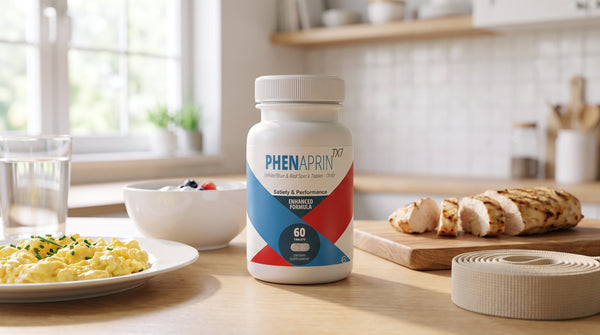
Glucomannan is the lead ingredient in PhenAprin XR, our caffeine-free, capsule formula built around physical, fiber-driven appetite control. You can see the full per-serving amounts and references on the Ingredients page, and how the formula's pathways fit together on The Science. Every batch is third-party tested; see the Certificate of Analysis.
One more angle worth knowing: if your challenge is constant mental chatter about food rather than physical hunger, that experience now has a name and a science of its own. Our guide to what food noise is and how to quiet it explains it, and where fiber-based fullness fits in.
These statements have not been evaluated by the Food and Drug Administration. This product is not intended to diagnose, treat, cure, or prevent any disease.