L-Phenylalanine and Food Noise: How an Amino Acid Supports Satiety
How L-phenylalanine supports the body's CCK satiety signaling to help quiet food noise.
By PhenAprin Research Team
Reviewed against published researchPublished · Last updated September 11, 2026
On this page
Quick answer
Key takeaways
- L-phenylalanine is an essential amino acid your body gets from dietary protein, and research connects it to the gut satiety hormone cholecystokinin (CCK).
- Through the calcium-sensing receptor in the gut, it is associated with releasing CCK, which signals fullness to the brain and slows gastric emptying.
- As a precursor to tyrosine and then dopamine, it also supports healthy dopamine pathways involved in appetite regulation, the same wiring people describe with "food noise."
- PhenAprin Original provides 230 mg per serving, an honest supportive dose that contributes within the formula rather than reproducing the 5,000 to 10,000 mg used in CCK studies.
- People with phenylketonuria (PKU) must avoid phenylalanine, and people taking levodopa for Parkinson's should consult a physician first.
What is L-phenylalanine, and why does it matter for appetite?
L-phenylalanine (L-Phe) is an essential amino acid, meaning your body cannot make it and has to get it from dietary protein. Beyond its role as a building block, research describes something interesting it does in the gut: it is thought to interact with the calcium-sensing receptor (CaSR) on gut cells.
That receptor matters because of what research associates with it. When L-Phe interacts with CaSR, research describes a downstream release of satiety signaling, including the gut hormone cholecystokinin. In other words, an amino acid you already get from food is also part of how your gut tells your brain it has had enough.
You can see how this fits into the broader formula on the PhenAprin Original product page and the full ingredients breakdown.
How does L-phenylalanine support satiety through CCK?
The mechanism is best described the way the research frames it. L-phenylalanine is thought to support the release of cholecystokinin (CCK), a well-established satiety hormone. Research associates CCK with two things that matter when you are trying to eat less without fighting yourself the whole time:
- It is associated with signaling fullness to the brain through vagal pathways.
- It is associated with slowing gastric emptying, which helps food stay in the stomach longer and may support a smaller meal size.
This is the part of the formula focused on supporting the body's own "I am full" signaling rather than on willpower.
The research here is specific. In a study by Ballinger and Clark (1994), 10 g of L-phenylalanine raised plasma CCK roughly 5-fold and was associated with about a 31% reduction in caloric intake compared with placebo (PMID 8201963). A later study by Fitzgerald and colleagues (2020) found that 10 g stimulated CCK and was associated with reduced energy intake in a group of 16 men (PMID 32560181). Those are study figures from controlled settings, they stay with the studies that produced them, and individual results vary.
There is also broader work on the pathway itself. Alamshah and colleagues (2017) describe how the CaSR pathway is associated with the gut satiety hormones CCK, PYY, and GLP-1 (DOI 10.1038/ijo.2017.164). That is the same family of appetite-regulating signals discussed across the GLP-1 conversation, which is why this mechanism gets so much attention right now.
You can read more about how these mechanisms inform the formula on the science behind PhenAprin.
What is "food noise," and how does L-phenylalanine relate to it?
"Food noise" is the term many people use for the intrusive, hard-to-quiet food thoughts that show up while dieting. The phrase got popular through the GLP-1 conversation, where users described their constant food chatter quieting down. It is a real, relatable experience even though it is not a medical diagnosis.
L-phenylalanine connects to this through a secondary role. It is a precursor to tyrosine, which the body then uses to make dopamine. Through that route, L-phenylalanine supports healthy dopamine pathways involved in appetite regulation, the same reward-related wiring that plays a part in how food thoughts show up and how satisfying eating feels.
To be clear about what this is and is not: this is a structure and function story about supporting normal appetite-related pathways. It is not a claim to treat, cure, or prevent anything.
How much L-phenylalanine is in PhenAprin Original?
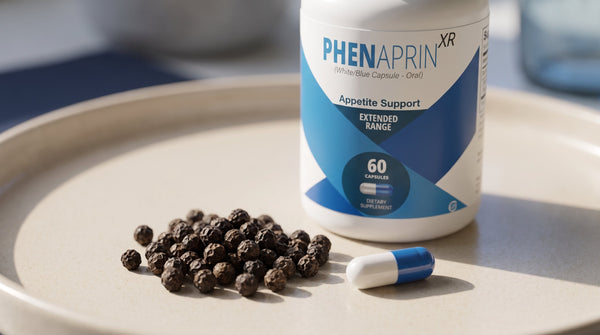
PhenAprin Original provides 230 mg of L-phenylalanine per serving (1 tablet, 540 mg total).
Here is the honest framing. The CCK studies cited above used much larger amounts, in the range of 5,000 to 10,000 mg. So the 230 mg in PhenAprin Original is best understood as a supportive dose, contributing to the formula rather than reproducing those clinical study levels on its own. L-phenylalanine in PhenAprin Original works alongside the other ingredients in the formula, not in isolation.
We would rather tell you that plainly than imply a single supportive dose does what a 10 g research dose did. You can compare servings and see the rest of the formula on the PhenAprin Original product page.
Who should not take L-phenylalanine?
A few groups need to be careful, and these are not optional notes:
- People with phenylketonuria (PKU) must avoid phenylalanine entirely. This is a firm contraindication.
- People taking levodopa for Parkinson's: L-phenylalanine may compete with levodopa absorption, so talk with your physician before using a product that contains it.
As with any supplement, if you take prescription medication or manage a health condition, check with your healthcare provider first. PhenAprin Original is a supplement, not a medication, and not a substitute for any prescription.
These statements have not been evaluated by the Food and Drug Administration. This product is not intended to diagnose, treat, cure, or prevent any disease. Individual results vary.
Frequently asked questions
Does L-phenylalanine suppress hunger?
L-phenylalanine is thought to support the body's own satiety signaling rather than override hunger. Research describes it interacting with the calcium-sensing receptor in the gut, which is associated with release of the satiety hormone CCK that signals fullness to the brain and slows gastric emptying. It supports natural fullness pathways, it is not an appetite suppressant drug, and individual results vary.
How is L-phenylalanine related to GLP-1?
GLP-1 is one of several gut hormones in the satiety family. Alamshah and colleagues (2017) describe how the calcium-sensing receptor pathway is associated with CCK, PYY, and GLP-1 (DOI 10.1038/ijo.2017.164). L-phenylalanine relates to that same family of appetite-regulating signals. PhenAprin Original is a supplement, not a medication, and not a substitute for any prescription.
Will 230 mg do the same thing as the doses in the studies?
No, and we will not pretend otherwise. The CCK studies used 5,000 to 10,000 mg, while PhenAprin Original provides 230 mg per serving. That is a supportive dose that contributes within the broader formula, not a reproduction of clinical study levels. Study figures stay with the studies that produced them, and individual results vary.
Can L-phenylalanine help with "food noise"?
"Food noise" describes intrusive food thoughts that many people report while dieting; it is a concept popularized by GLP-1 users, not a medical diagnosis. L-phenylalanine is a precursor to tyrosine and then dopamine, so it supports healthy dopamine pathways involved in appetite regulation. It supports a calm, focused state around eating rather than treating any mood condition.
Is L-phenylalanine safe for everyone?
No. People with phenylketonuria (PKU) must avoid phenylalanine, and people taking levodopa for Parkinson's should consult a physician because L-phenylalanine may compete with levodopa absorption. If you take prescription medication or have a health condition, talk with your healthcare provider before use.
References
- Ballinger AB, Clark ML. 1994. L-phenylalanine releases cholecystokinin (CCK) and is associated with reduced food intake in humans. PMID 8201963.
- Fitzgerald PCE, et al. 2020. L-phenylalanine stimulated CCK and suppressed energy intake in 16 men. PMID 32560181.
- Alamshah A, et al. 2017. The calcium-sensing receptor pathway modulates CCK, PYY, and GLP-1. DOI 10.1038/ijo.2017.164.

From PhenAprin
PhenAprin Diet Pills
Transparent label, honest dosing, third-party tested.
See the formulaFind your fit
Find the PhenAprin formula that fits your routine
Three formulas, one transparent label. Compare them and choose the one built for your day.