Quick answer
Black pepper fruit extract supplies piperine, a bioavailability enhancer. It is studied for its ability to support how much of the compounds you take alongside it actually reach your bloodstream, by working with two of the body's natural "first-pass" filtering systems. In one human study, piperine was associated with substantially higher curcumin absorption. That is why a 5 mg dose sits inside PhenAprin XR.
Key takeaways
- Piperine is the active compound in black pepper extract. It is a bioavailability enhancer, not a headline ingredient, included to help the ingredients around it be absorbed.
- It works with two of the body's natural filtering systems: the CYP3A4 first-pass enzyme and the P-glycoprotein efflux pump.
- In a 1998 human study, adding piperine was associated with a large increase in curcumin absorption, a compound that is notoriously hard to absorb.
- PhenAprin XR includes 5 mg of piperine per 2-capsule serving, the same amount used in research on the branded BioPerine form.
- Because piperine can affect how substances are absorbed, anyone taking prescription medication should consult a physician before use.
What is black pepper extract and piperine?
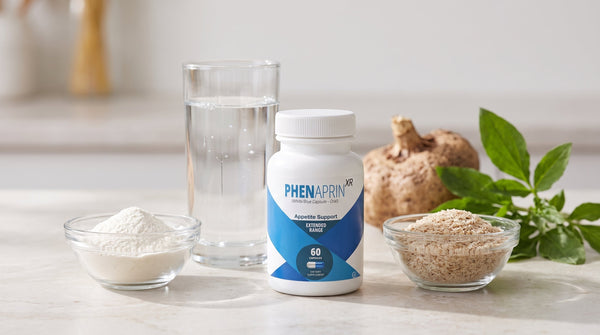
Black pepper (Piper nigrum) is the same fruit that fills your pepper grinder, but the extract used in supplements is concentrated for one active compound: piperine. Piperine is what researchers call a bioenhancer, or bioavailability enhancer. On its own it is not the headline ingredient. Its job is to help the ingredients around it work better.
That distinction matters. Most of what makes a formula effective is not just what goes into the capsule, it is how much of each compound survives the trip into your bloodstream. Piperine is included specifically to support that trip.
How does piperine support absorption?
When you swallow a supplement, your body naturally processes much of it before it ever circulates. Two systems do most of that processing, and piperine has been studied for the way it interacts with both.
It may influence a first-pass metabolism enzyme (CYP3A4)
CYP3A4 is an enzyme found in the liver and intestine that is involved in processing many compounds during what is called first-pass metabolism, the body's initial handling of anything you ingest. Research suggests piperine can temporarily influence CYP3A4 activity, which may help more of a co-ingested compound stay intact as it is absorbed.
It may ease an efflux pump (P-glycoprotein)
P-glycoprotein is an efflux transporter, a kind of pump in intestinal cells that moves certain compounds back out before they can be absorbed. Research suggests piperine may temporarily reduce the activity of this pump as well. With that pump dialed down, more of a compound can stay inside the cell and continue on into circulation.
Together, these two effects are why a small amount of piperine can have an outsized impact: it is not adding anything new, it is supporting how much of everything else gets absorbed rather than filtered out.
What does the research say?
The most cited evidence comes from a human study by Shoba and colleagues in 1998 (PMID 9619120). In that study, adding piperine was associated with markedly higher bioavailability of curcumin, a notoriously hard-to-absorb compound, reported as an increase of about 2,000 percent.
Curcumin is not the only example. A series of studies by Badmaev and colleagues found that 5 mg of piperine was associated with increased absorption of several common nutrients, including selenium, beta-carotene, vitamin B6, vitamin C, and CoQ10. The 5 mg figure is meaningful: it is the standard dose studied, the amount delivered by the branded BioPerine form used in research.
How much piperine is in PhenAprin XR?
PhenAprin XR includes 5 mg of piperine per 2-capsule serving, the same amount used in research. Inside the formula, it is intended to do the same thing it does in the studies: support the absorption of the other ingredients in the blend. That is what we mean when we describe XR as an enhanced absorption formula. The goal is to help each ingredient be absorbed rather than filtered out before it has a chance to be used.
You can see how piperine fits alongside the rest of the blend on the PhenAprin ingredients page, and read more about the formulation approach on The Science page. Every batch is third-party tested; see the Certificate of Analysis.
Is black pepper extract safe?
Black pepper has a long history as a common food. The consideration with piperine is not the pepper itself, it is exactly the property that makes it useful: because piperine can affect how other substances are absorbed, it can in principle affect how medications are absorbed too. For that reason, anyone taking prescription medication should consult a physician before adding a piperine-containing supplement. This is general guidance, not medical advice, and your doctor knows your situation best.
These statements have not been evaluated by the Food and Drug Administration. This product is not intended to diagnose, treat, cure, or prevent any disease.