Glucomannan vs Psyllium: Which Fiber Is Better for Fullness?
By PhenAprin Research Team
Reviewed against published researchPublished · Last updated October 22, 2026
On this page
Quick answer
Key takeaways
- Glucomannan (from konjac root) and psyllium (from Plantago ovata seed husks) are both viscous, gel-forming soluble fibers, the fiber type research links most strongly to a feeling of fullness.
- Glucomannan is among the most water-absorbent dietary fibers known, forming a thick gel that supports stomach fullness at small gram amounts.
- Psyllium has the broadest overall evidence base: bulking and regularity, post-meal fullness, and an FDA-authorized health claim for heart health at 7 grams of soluble fiber per day.
- For appetite control specifically, glucomannan's gram-for-gram viscosity is the standout; for all-purpose daily fiber, psyllium is hard to beat.
- Every gel fiber comes with the same non-negotiable rule: take it with plenty of water, never dry, and never right before bed.
What do glucomannan and psyllium have in common?
More than marketing would suggest. Both are soluble fibers that dissolve and swell in water rather than passing through unchanged. Both form a viscous gel in the stomach and small intestine. And that gel is the point: research on functional fibers shows that viscous, gel-forming fibers are the category that meaningfully slows stomach emptying and supports the physical side of fullness, while non-viscous fibers mostly do not (PMID 27863994).
So the real comparison is not "fiber vs fiber." It is two members of the same elite category, each with a different specialty.
What is glucomannan best at?
Holding water. Glucomannan, extracted from the root of the konjac plant, has one of the highest water-holding capacities of any common dietary fiber: it can absorb up to roughly 100 times its weight in water. In the stomach, that means a small amount of powder becomes a substantial, slow-moving gel that gently stretches the stomach and slows emptying, which is the mechanical basis of feeling full.
The honest read of the clinical record: trial results on weight itself are mixed. A 2014 meta-analysis of randomized trials found no statistically significant pooled weight loss versus placebo (PMID 24533610), while a critical review of 12 trials at 2 to 4 grams per day found it well tolerated (PMID 16320857). The strongest anchor is regulatory: in the European Union, glucomannan carries an authorized weight-management health claim in the context of an energy-restricted diet at 3 grams per day (EFSA, 2010). Fullness support is its clearest job; weight change still comes from the diet around it.
Our full breakdown, including honest dosing context, lives in the glucomannan guide.
What is psyllium best at?
Being the dependable all-rounder. Psyllium, milled from Plantago ovata seed husks, forms a softer gel that holds water through the full length of the gut, which is why it is the reference fiber for regularity and stool consistency (PMID 27863994).
Psyllium also has the strongest regulatory pedigree in the fiber aisle: the FDA authorizes a health claim that soluble fiber from psyllium seed husk, at 7 grams or more per day as part of a diet low in saturated fat and cholesterol, may reduce the risk of coronary heart disease (21 CFR 101.81). That claim belongs to psyllium at that dose, and we state it here as education, not as a claim about any PhenAprin product.
On appetite, psyllium holds its own: a randomized study in healthy volunteers found psyllium taken before meals increased fullness and reduced hunger between meals versus placebo (Brum et al., Appetite, 2016).
Which one should you choose for appetite control?
Choose glucomannan when fullness is the job. Gram for gram, its water-holding capacity and gel thickness are the standout, which is why it can support meal-time fullness at capsule-sized amounts rather than tablespoon-sized doses. It is the natural fit if your struggle is portions, snacking, and the feeling of never quite being satisfied.
Choose psyllium when regularity or heart health is the job. Its evidence base for stool consistency is unmatched among gel fibers, and the 7 grams per day heart-health context is its home turf.
You do not have to choose forever. They are different tools from the same drawer. Many people use a glucomannan-based product around meals for fullness and get their bulk fiber from food or psyllium at another time of day. If you take both, space them out, drink water with each, and keep your total fiber increase gradual so your gut can adjust.
Food still comes first. Beans, oats, vegetables, and fruit carry fiber plus everything else. Supplemental fiber is a targeted tool on top of a decent diet, not a replacement for one.
How do you take gel-forming fibers safely?
The same physics that makes these fibers work makes the water rule absolute.
Glucomannan: take each capsule with at least 8 oz (about 236 mL) of water, ideally 30 to 60 minutes before a meal. Never take it dry, never right before lying down or before bed, and do not take it at all if you have any difficulty swallowing. Without enough fluid, a gel fiber can swell in the throat or esophagus and cause a blockage.
Psyllium: the same principle applies. Mix powders fully in a large glass of water and drink promptly, and follow the label's fluid guidance.
Both: start low and build up over a week or two (gas and bloating in the first days usually settle), and take fiber separately from prescription medications, since gels can slow how other things absorb. If you take medication or have any digestive condition, check with your healthcare provider first.
Where does PhenAprin XR fit?
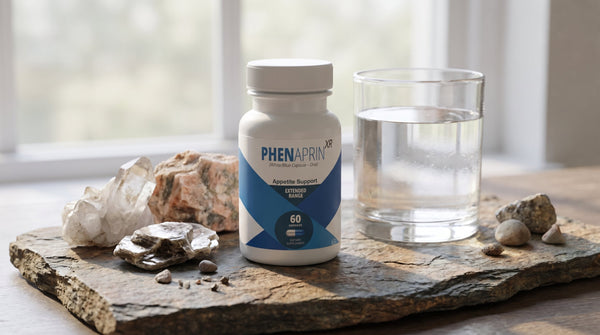
PhenAprin XR is our caffeine-free formula built around glucomannan for exactly the fullness job this article describes: 800 mg of glucomannan per 2-capsule serving, up to 1,600 mg across the daily allowance of two servings, taken with at least 8 oz of water per capsule before meals. The honest context: that is a meaningful, supportive amount within a fiber-based formula, and it sits below the 3 grams per day used in the EU weight-management claim. You can compare every ingredient and amount on the ingredients page, and see how the formula approaches appetite in Appetite Control, Explained.
These statements have not been evaluated by the Food and Drug Administration. This product is not intended to diagnose, treat, cure, or prevent any disease. Individual results vary.
Frequently asked questions
Is glucomannan or psyllium better for weight loss?
For meal-time fullness, glucomannan is the specialist: its gram-for-gram gel thickness is among the highest of common fibers, and the EU authorizes a weight-management claim for it at 3 grams per day within an energy-restricted diet. Weight-loss trial results for both fibers are mixed, and neither is a magic pill; both work alongside diet, not instead of it. Psyllium's strongest evidence is for regularity and heart health.
Can I take glucomannan and psyllium together?
Generally yes, at different times of day, each with plenty of water. Increase total fiber gradually to let your gut adjust, and keep fiber separate from prescription medications since gels can slow absorption. Ask your healthcare provider if you take medication or have a digestive condition.
Why does glucomannan need so much water?
Because it absorbs up to roughly 100 times its weight in water and swells into a gel. With at least 8 oz of water per capsule, that expansion happens safely in your stomach. Taken dry or right before lying down, it can swell in the throat or esophagus, which is why the warning is absolute: never without water, never at bedtime, and never with any swallowing difficulty.
Does psyllium really help your heart?
The FDA authorizes a health claim that soluble fiber from psyllium seed husk, at 7 grams or more per day within a diet low in saturated fat and cholesterol, may reduce the risk of coronary heart disease (21 CFR 101.81). That is psyllium's claim at that specific dose, not a claim about PhenAprin products.
How much glucomannan is in PhenAprin XR?
800 mg per 2-capsule serving, up to 1,600 mg across the daily allowance of two servings. That is a supportive amount within a caffeine-free, fiber-based formula, and it is below the 3 grams per day used in the EU authorized weight-management claim.
References
- PMID 27863994. McRorie JW, McKeown NM. Understanding the physics of functional fibers in the gastrointestinal tract. Journal of the Academy of Nutrition and Dietetics, 2017. [link]
- Brum 2016. Brum JM, et al. Satiety effects of psyllium in healthy volunteers. Appetite, 2016. [link]
- PMID 24533610. Onakpoya I, et al. The efficacy of glucomannan supplementation in overweight and obesity: a systematic review and meta-analysis of randomized clinical trials. 2014. [link]
- PMID 16320857. Keithley J, Swanson B. Glucomannan and obesity: a critical review. Alternative Therapies in Health and Medicine, 2005. [link]
- 21 CFR 101.81. U.S. Food and Drug Administration. Health claims: soluble fiber from certain foods and risk of coronary heart disease. [link]
- EFSA 2010. EFSA Panel on Dietetic Products, Nutrition and Allergies. Scientific opinion on konjac mannan (glucomannan) and weight reduction. EFSA Journal, 2010. [link]

From PhenAprin
PhenAprinXR Diet Pills
Transparent label, honest dosing, third-party tested.
See the formulaFind your fit
Find the PhenAprin formula that fits your routine
Three formulas, one transparent label. Compare them and choose the one built for your day.