Quick answer
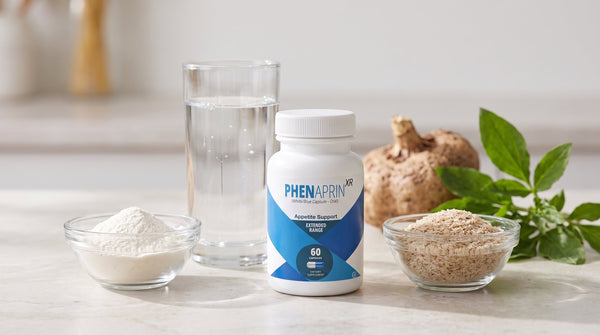
7-Keto DHEA is a naturally occurring, non-hormonal metabolite of DHEA. Unlike DHEA, it is not converted into testosterone or estrogen and is reported not to affect sex hormones when taken orally. Researchers have studied it for supporting resting metabolic rate, especially during caloric restriction. PhenAprin Original includes it at a supportive 10 mg per serving.
Key takeaways
- 7-Keto DHEA is a non-hormonal metabolite of DHEA. Unlike DHEA, it is not converted into testosterone or estrogen and is reported not to affect sex hormone levels when taken orally.
- Research interest centers on supporting healthy resting metabolic rate, especially during caloric restriction, and on thermogenic enzyme activity observed in controlled settings.
- Cited studies used 200 mg per day. PhenAprin Original provides 10 mg per tablet, a supportive, trace metabolic-modulator amount included as one part of the formula, so study figures stay attributed to those studies and individual results vary.
- 7-Keto DHEA is on the WADA prohibited list. Tested athletes should not use it without confirming their eligibility rules.
- Talk to a physician first if you take anticoagulant or antiplatelet medication, have a thyroid disorder, or have a hormone-sensitive condition. It is not recommended for women who are pregnant or nursing.
What is 7-Keto DHEA, and why "non-hormonal"?
7-Keto DHEA (formally 7-keto DHEA acetate) is a metabolite the body makes from DHEA. The distinction that matters most for a supplement label is what it does not do. Unlike DHEA itself, 7-Keto DHEA is not converted into testosterone or estrogen, and research indicates it does not affect sex hormone levels when taken orally. That is the basis for describing it as a non-hormonal metabolite rather than a hormone.
This is why people sometimes confuse the two ingredients. They share part of a name and a biochemical lineage, but they behave differently in the body. If sex hormone activity is a concern, the non-hormonal profile of 7-Keto DHEA is the practical reason it shows up in metabolic formulas instead of DHEA.
How is 7-Keto DHEA thought to support metabolic rate?
The research interest in 7-Keto DHEA centers on resting metabolic rate, which is the energy your body uses at rest. It has been studied specifically for supporting healthy resting metabolic rate during caloric restriction, the period when many people notice their metabolism feels slower.
Researchers have also looked at its role in thermogenic enzyme activity, the enzymes involved in heat and energy production. This is described in the research literature as relative activity observed in controlled settings, not a promise about what any individual will feel.
A related research idea involves cortisol and an enzyme called 11-beta-HSD1. This is best understood as a research mechanism under study, not a drug action and not an established effect of the ingredient. We mention it here only because it appears in the scientific discussion of how 7-Keto DHEA is being investigated.
What does the research actually show?
A few studies anchor the conversation. Their figures are attributed to the studies that produced them, and individual results vary.
- A systematic review of randomized controlled trials examined 7-Keto DHEA, with some trials reporting weight reduction and some reporting an increase in resting metabolic rate.
-
Zenk et al. (2005) studied 7-Keto DHEA at 200 mg per day and reported an increase in resting metabolic rate relative to a placebo group.
-
Kalman et al. (2000) studied 7-Keto DHEA at 200 mg per day over 8 weeks and reported greater weight change in the active group than in the placebo group.
These findings belong to the studies that produced them. They are not a prediction of personal results, and they were generated at a much higher daily intake than a supportive supplement dose, which we address next.
How does PhenAprin's dose compare to the studies?
Honesty matters here. PhenAprin Original provides 10 mg of 7-Keto DHEA per tablet (540 mg total tablet weight), while the studies above used 200 mg per day. That makes the amount in PhenAprin Original a supportive, trace metabolic-modulator level rather than a clinical dose.
We include it as one supporting component in a broader formula, not as a standalone replacement for the doses used in research. If you want to understand how each ingredient is positioned and why, the full breakdown is on the PhenAprin ingredients page, and the research framing for the formula lives on the science behind PhenAprin. You can see the complete supplement facts on the PhenAprin Original product page, and our third-party testing on the PhenAprin certificate of analysis.
Who should be cautious with 7-Keto DHEA?
A few groups should take extra care, and some should talk to a clinician first.
-
Tested athletes: 7-Keto DHEA is on the WADA prohibited list. If you compete in a tested sport, do not use it without confirming your eligibility rules.
- Consult a physician before use if you take anticoagulant or antiplatelet medication.
- Consult a physician before use if you have a thyroid disorder.
- Consult a physician before use if you have a hormone-sensitive condition.
- 7-Keto DHEA is not recommended for women who are pregnant or nursing.
As with any supplement, PhenAprin Original is a supplement, not a medication, and is not a substitute for any prescription. When in doubt, your own physician is the right person to clear it for your situation.
These statements have not been evaluated by the Food and Drug Administration. This product is not intended to diagnose, treat, cure, or prevent any disease.