Gray-Market GLP-1 and Peptide Injectables: What the FDA Warns About
The FDA's own warnings on gray-market GLP-1 and peptide injectables, and the safe path if you use a prescription program.
By PhenAprin Research Team
Reviewed against published researchPublished · Last updated November 9, 2026
On this page
Quick answer
Key takeaways
- The FDA names four problem lanes: compounded versions that lack FDA review, counterfeit products, "research use only" vials marketed for human use, and unauthorized online sellers.
- The risks in the agency's own words include dosing errors that have led to hospitalizations, unknown ingredients, unstudied salt forms, and storage and contamination problems.
- In 2026 the FDA issued repeated rounds of warning letters to online peptide sellers. The August letter it posted rejected "research use only" labeling as a shield.
- The safe path is short and boring: a prescription from your clinician, filled at a state-licensed pharmacy.
- None of this is about dietary supplements. No supplement contains GLP-1 or any injectable drug, and an honest supplement label says plainly what it is.
What counts as a gray-market GLP-1 or peptide injectable?
The legitimate path for a GLP-1 class medicine runs from an approved manufacturer through a prescriber and a state-licensed pharmacy to you. Everything else is the gray market: vials compounded outside the usual safeguards, counterfeits dressed up as the real product, and "research peptides" sold by websites to anyone with a card number.
The gray market exists because the demand is real and the legitimate path can be expensive or out of reach. In our own Amazon search data from August 2026, shoppers ran more than 9,000 monthly searches for "peptides for weight loss" and thousands more for related phrasings. Those searches are the sound of people looking for a side door. The FDA's documents, read together, are a warning about what is behind it.
What exactly has the FDA warned about?
The FDA maintains a standing public page on its concerns with unapproved GLP-1 class products used for weight loss, and it was updated as recently as October 1, 2026. It groups the problem into four lanes.
First, compounded versions. Compounding is legal in narrow circumstances, but compounded drugs are not FDA-approved, which means no agency review of safety or effectiveness before they are sold. Second, counterfeit products, which can contain the wrong ingredient, the wrong amount, or nothing useful at all. Third, products labeled "for research use only" that are marketed, with dosing instructions, to people who intend to inject them. Fourth, unauthorized online sellers who move all of the above.
If you remember one structural fact, make it this one: the agency's concern is not the medicine class itself, which remains a prescriber's tool. The concern is every channel that routes around the prescription system.
What risks does the FDA actually name?
The FDA's page on unapproved GLP-1 products is specific about what goes wrong with gray-market versions, and none of it is hypothetical.
Dosing errors lead the list: errors made while self-administering, and miscalculations by providers, with mistakes that have ended in hospitalization. Then ingredient uncertainty: counterfeit and fraudulent products with unknown contents and quality. Then chemistry: compounders using salt forms of the active ingredients that lack FDA safety data. And finally handling: products that degrade in shipping and storage, and multi-dose vials that carry contamination risk when used beyond their window.
Every one of those risks is a consequence of leaving the regulated chain, where each step exists precisely to prevent that failure.
What happened with the 2026 warning letters?
Twice in 2026, in a March round and again in a round dated August 24, the FDA sent warning letters to online peptide sellers.
The August letter the agency posted makes two moves worth understanding. It classifies the products, injectable peptides including GLP-1 class substances, as unapproved new drugs under the Federal Food, Drug, and Cosmetic Act, which makes selling them a violation regardless of any disclaimer. And it walks through the seller's own marketing, showing therapeutic claims aimed at human buyers, which is how the agency rejects the "research use only" defense. It demands a written response within 15 business days describing corrective actions.
We cover the border side of the same enforcement story, including the import alert that now applies to this drug class's bulk ingredients, in a companion guide to the import alerts.
Why doesn't "research use only" make it legal?
"Research use only" describes laboratory chemicals sold to institutions for experiments, not products for people. The label is legitimate in a lab-supply catalog. On a website that also publishes human dosing guidance and benefit claims, it's a costume.
The August 24 letter the FDA posted says this directly: despite labeling that declared the products for research use only and not for human use, the seller's site marketed them for human benefit, which makes them unapproved drugs. A disclaimer cannot un-sell what the rest of the page is selling. If a vial reaches your door because a checkout page let it, the research label protected the seller's hope of cover, not your safety.
Is it safe to buy peptides or GLP-1 medicines online?
Only through the front door. The FDA's consumer advice is one sentence long: get a prescription from your doctor and fill it at a state-licensed pharmacy. That single habit removes essentially every risk on the agency's list, because each one lives outside that chain.
For buying medicine online specifically, the agency runs BeSafeRx, a plain-language resource for telling licensed online pharmacies from the other kind. And if you have already used a product you suspect, you can report problems to the FDA through its MedWatch program, which is how the agency finds out when the gray market hurts someone.
One more honest step: talk to your prescriber about cost. The gray market recruits from people priced out of the legitimate one, and prescribers deal with that constraint every day.
What does any of this mean for supplements?
A boundary, clearly drawn. A dietary supplement is not an injectable, contains no GLP-1 and no drug, and makes no claim to do a medication's job. If you're weighing a product that borrows the class's name, our guide to reading a label that borrows the GLP-1 name shows what to check in five minutes.
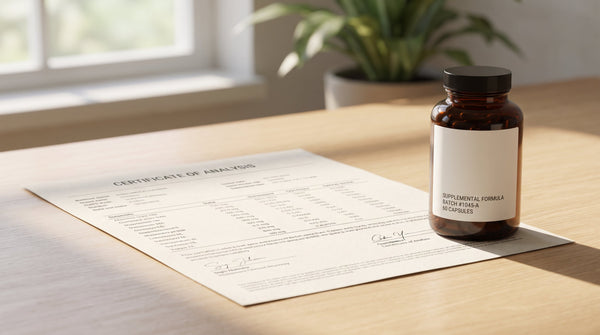
What an honest supplement offers instead is proof and modesty. PhenAprin XR is a caffeine-free, fiber-first formula built around glucomannan, 800 mg per two-capsule serving, printed on the label, a supportive amount below the 3 g per day used in the European weight-management claim context. The standing glucomannan rule applies: take each capsule with at least 8 oz of water, never right before bed, and not at all if you have difficulty swallowing. Every batch is third-party tested and the results are published on our Certificate of Analysis page. It supports natural satiety as a companion to your routine, including around a prescription program, as we explain in supporting appetite on a GLP-1 journey. It is a supplement, not a medication, and not a substitute for any prescription treatment.
That's what the real thing looks like in this category: a label that says exactly what it is, and documents that prove it.
These statements have not been evaluated by the Food and Drug Administration. This product is not intended to diagnose, treat, cure, or prevent any disease.
Frequently asked questions
What is a gray-market GLP-1 injectable?
A gray-market GLP-1 injectable is a version of a prescription weight-loss medicine obtained outside the regulated chain of approved manufacturer, prescriber, and state-licensed pharmacy. The FDA's warnings cover four problem categories: compounded versions lacking FDA review, counterfeit products, "research use only" vials marketed for human use, and the unauthorized online sellers who move them.
Are compounded GLP-1 medicines safe?
Compounded GLP-1 medicines are not FDA-approved, which means the agency has not reviewed their safety or effectiveness before sale. Compounding is legal only in narrow circumstances, and the FDA has flagged added risks in this category, including salt forms of active ingredients that lack FDA safety data.
What does the FDA's BeSafeRx program do?
BeSafeRx is the FDA's consumer campaign for buying prescription medicine online safely. It explains how to recognize a licensed online pharmacy and the warning signs of an unsafe one. It is the agency's checklist for the exact channel the gray market uses.
How do I report a bad product to the FDA?
Report suspected problems with a drug product, including anything bought online that caused harm or looks counterfeit, through the FDA's MedWatch program, which accepts reports from consumers online. Reporting matters: it is how the agency hears about problems with products sold outside the regulated chain.
Can a supplement replace a prescription injectable?
No. A supplement cannot replace a prescription injectable, and no honest one claims to. A supplement contains no GLP-1 and no drug; it can support the body's own fullness signaling with ingredients like soluble fiber. Decisions about a medication, including starting, stopping, or affording one, belong with your prescriber.
References
- U.S. Food and Drug Administration. FDA's Concerns with Unapproved GLP-1 Drugs Used for Weight Loss. [link]
- U.S. Food and Drug Administration. Warning Letter, MARCS-CMS 735063 (August 24, 2026): unapproved new drug charges for injectable peptides, including GLP-1 class substances, sold online as research use only. [link]
- U.S. Food and Drug Administration. Import Alert 66-80: Detention Without Physical Examination of Glucagon-Like Peptide-1 (GLP-1) Receptor Agonist Bulk Drug Substances. [link]
- U.S. Food and Drug Administration. BeSafeRx: Your Source for Online Pharmacy Information. [link]

From PhenAprin
PhenAprinXR Diet Pills
Transparent label, honest dosing, third-party tested.
See the formulaFind your fit
Find the PhenAprin formula that fits your routine
Three formulas, one transparent label. Compare them and choose the one built for your day.