Is That "GLP-1 Supplement" Real? How to Read the Label
Why no supplement contains GLP-1, what the label has to show, and how to vet an appetite product before you buy.
By PhenAprin Research Team
Reviewed against published researchPublished · Last updated November 5, 2026
On this page
Quick answer
Key takeaways
- No pill, powder, gummy, or drop legally sold as a dietary supplement contains GLP-1 or any medicine in that class. Those are prescription drugs.
- "GLP-1 booster" and "GLP-1 support" are marketing phrases, not regulated product categories. The Supplement Facts panel on the back tells you what you're actually buying.
- Supplements are legal products with real rules: no FDA pre-approval, structure/function claims only, no disease claims, and a required disclaimer.
- The FTC requires competent and reliable scientific evidence behind health claims. Borrowed-name marketing with no evidence is exactly what that standard exists to catch.
- A trustworthy label shows every ingredient at a disclosed dose and is backed by a batch Certificate of Analysis you can actually read.
What does "GLP-1 booster" mean on a supplement label?
GLP-1 is a hormone your gut releases after you eat, one of several signals that tell your brain you are full. The prescription weight-loss medicines that dominate the conversation are built on that biology: they are GLP-1 receptor agonists, a drug class available only through a prescriber.
On a supplement label, the phrase means something different. It is borrowed language. A bottle that says "GLP-1 booster" or "GLP-1 support" is telling you which aisle it wants to sit in, not what's inside it.
The borrowing happens because the demand is enormous. In our own Amazon search data from August 2026, shoppers ran about 5,000 monthly searches for "glp1 booster," nearly 3,000 more for the hyphenated spelling, and tens of thousands more for branded booster phrasings. Those shoppers are asking a fair question. This article is the answer we think they deserve.
Can a supplement actually contain GLP-1?
No, a supplement does not contain GLP-1. This is a legal line, not a gray area. GLP-1 receptor agonist medicines are prescription drugs, and a capsule that truly contained one would be an unapproved drug, not a supplement. That is the territory the FDA polices with warning letters and import alerts. The claims boundary is just as plain: the FDA says a product promoted to treat, prevent, or cure disease "meets the definition of a drug" and is regulated as one.
So a supplement maker faces a fork. If the bottle truly contained a GLP-1 class ingredient, it would be an unapproved drug sold illegally. If it contains ordinary supplement ingredients, which is virtually always the case, then the GLP-1 phrasing on the front is doing work the contents cannot.
The FDA keeps a standing page on unapproved versions of this drug class, updated as recently as October 1, 2026. Its concern covers compounded versions, counterfeits, so-called research-use products, and unauthorized online sellers. None of those are dietary supplements either. They are drugs sold outside the system.
So what is actually inside a "GLP-1 support" product?
Open a "GLP-1 support" product's Supplement Facts panel and you'll usually find familiar categories: soluble fibers, botanical extracts, amino acids, vitamins, minerals, sometimes probiotics.
There's nothing wrong with those categories. Some have real, measurable effects on fullness. Soluble fiber is the clearest example: it absorbs water and adds volume in the stomach, a mechanical kind of satiety support we explain in our guide to glucomannan for appetite and fullness. Glucomannan's handling rule applies wherever its benefit comes up: take each capsule with at least 8 oz of water, never right before bed, and not at all if you have difficulty swallowing.
The honest questions are narrower. Is each ingredient dosed at a level with evidence behind it? Does the label disclose those doses, or hide them inside a "proprietary blend" total? And does the marketing claim the ingredient's real effect, or the drug's? A fiber can support fullness. It cannot do what a prescription medicine does, and a label that implies otherwise has left supplement territory in spirit even if its contents are legal.
What does the law require the label to show?
Under the law that created the modern supplement category, every product must carry a Supplement Facts panel listing the serving size and the amount of each dietary ingredient, an "other ingredients" list below it, the net quantity, and the manufacturer's or distributor's name and contact information.
Claims are regulated too. A supplement may make structure/function claims, statements about supporting a normal function of the body, like "supports satiety" or "supports metabolism." It may not claim to treat, prevent, or cure a disease. And every structure/function claim must sit next to the disclaimer you have seen on honest labels for years: that the statement has not been evaluated by the FDA.
One practical consequence is worth underlining. The front of the bottle is marketing. The Supplement Facts panel is the regulated part. When the two disagree, believe the panel.
Which claims cross the legal line?
The Federal Trade Commission polices advertising, and its standard is blunt: health claims need competent and reliable scientific evidence, which the FTC defines as tests and studies conducted and evaluated objectively by qualified experts, using methods the field accepts as accurate. Its compliance guidance, refreshed in December 2022, singles out weight-loss advertising for a reason.
Phrases that should end your reading early: anything promising specific pounds or timelines, "works like" or "replaces" a prescription medicine, "natural" versions of a drug class, and dramatic transformation stories standing in for evidence. A disclaimer in small print does not rescue a big-print promise; regulators judge the overall impression the ad leaves.
Our own rule on this site is stricter than the law requires: we describe what an ingredient supports, cite the research behind it, and state our doses against the study doses honestly, even when the comparison is modest.
How do you vet any appetite supplement in five minutes?
Vetting any appetite supplement comes down to five checks, in order:
- Every ingredient has a disclosed dose. A proprietary blend total hides the one number you need. We print every dose on every product, which is why we can tell you plainly that PhenAprin XR provides 800 mg of glucomannan per two-capsule serving, a supportive amount below the 3 g per day used in the European weight-management claim context. Any glucomannan product also carries a non-negotiable handling rule: take each capsule with at least 8 oz of water, never right before bed, and not at all if you have difficulty swallowing.
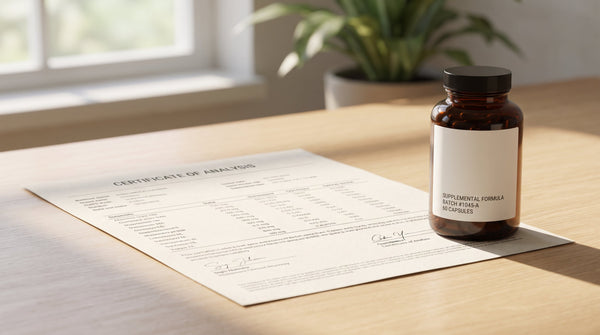
- A batch Certificate of Analysis exists and you can read it. A COA is a lab's report on what is actually in the bottle. Ours is published for every batch on our Certificate of Analysis page, and our guide to reading a COA shows you what the numbers mean on anyone's report, not just ours.
- The company identifies itself. A name, a place of business, a facility standard. US manufacturing in a cGMP facility is a checkable statement, not a vibe.
- The claims stay in support language. "Supports fullness between meals" is a supplement claim. A promise to work like a prescription medicine is not.
- The dose matches the evidence story. If a label cites fiber research at grams and delivers milligrams, the honest version of that label says so. We built that honesty into our own pages, because shoppers who were burned once check twice.
You can see every ingredient and dose across our three formulas on the ingredients page.
Where does an honest supplement fit alongside a GLP-1 program?
An honest supplement fits alongside a GLP-1 program as a companion, and nothing more. A supplement is not a medication and not a substitute for any prescription treatment, and questions about your medication belong with your prescriber.
What a well-built formula can honestly offer is support for the body's own fullness signaling: fiber that adds physical volume, ingredients that support the routine around your program. That is the thinking behind PhenAprin XR, our caffeine-free, fiber-first formula, and it is the lens of our whole GLP-1 companion support hub, including our guide to supporting appetite on a GLP-1 journey.
In our August 2026 shopper survey, the phrase respondents reached for most was that PhenAprin "quiets food noise." That is shopper language for satiety support, and it's the strongest claim we make, because it's the phrase shoppers themselves hand us.
These statements have not been evaluated by the Food and Drug Administration. This product is not intended to diagnose, treat, cure, or prevent any disease.
Frequently asked questions
What is a "GLP-1 supplement"?
A "GLP-1 supplement" is a marketing phrase, not a regulated category. It describes ordinary dietary supplements, usually fibers, botanicals, amino acids, or vitamins, sold with the drug class's name on the front. The phrase tells you what demand the product is chasing; only the Supplement Facts panel tells you what is inside.
Can a dietary supplement contain GLP-1 or a GLP-1 medicine?
No. GLP-1 and the medicines built on it are prescription drugs, and a pill or drop that truly contained one would be an unapproved drug, not a supplement. Real supplements contain food-derived ingredients that can support the body's own fullness signals, which is a different and more modest job.
Is a "GLP-1 booster" the same as the prescription medicine?
No. A "GLP-1 booster" is a supplement wearing the drug class's name. The medicines are prescribed and monitored by clinicians and act directly on hormone receptors. A supplement can support normal satiety and appetite-control routines but cannot reproduce a medication's effects, and any label implying it can has crossed the line regulators police.
What should a supplement label always show?
A supplement label must carry a Supplement Facts panel with the serving size and the amount of each dietary ingredient, an "other ingredients" list, the net quantity, and the maker's name and contact information. Structure/function claims must carry the FDA disclaimer. If doses hide inside a "proprietary blend" total, you cannot verify the one thing that matters.
How do I check whether a supplement is really third-party tested?
Ask for the batch Certificate of Analysis, the lab report behind the "tested" claim. A real one names the product and batch, lists each ingredient's measured amount, and screens for contaminants. We publish ours for every batch, and our guide to reading a COA shows what the numbers mean on any brand's report.
Do "GLP-1 supplements" work?
"GLP-1 supplements" work only in the supplement sense: ingredients like soluble fiber can genuinely support fullness and the routine around eating, and nothing in a capsule reproduces a prescription medicine's effects. Judge any product by its Supplement Facts panel: real doses of ingredients with real evidence, honest claims, and a batch test you can read.
References
- U.S. Food and Drug Administration. Questions and Answers on Dietary Supplements (label requirements, permitted claims, and the required disclaimer). [link]
- U.S. Food and Drug Administration. FDA's Concerns with Unapproved GLP-1 Drugs Used for Weight Loss. [link]
- Federal Trade Commission. Health Products Compliance Guidance, December 2022 (the competent and reliable scientific evidence standard). [link]

From PhenAprin
PhenAprinXR Diet Pills
Transparent label, honest dosing, third-party tested.
See the formulaFind your fit
Find the PhenAprin formula that fits your routine
Three formulas, one transparent label. Compare them and choose the one built for your day.