Peptides From China: What FDA Import Alerts and Warning Letters Say
An FDA import alert now lets border staff detain GLP-1 bulk substances without examining them. What the documents say, and how to protect yourself.
By PhenAprin Research Team
Reviewed against published researchPublished · Last updated November 12, 2026
On this page
Quick answer
Key takeaways
- Import Alert 66-80, updated September 21, 2026, targets GLP-1 class bulk drug substances for detention without physical examination at the border.
- The FDA evaluated 48 supplier sites for these ingredients and found 21 percent out of compliance with manufacturing standards, alongside a documented pattern of firms registering, offering product, refusing records requests, and deregistering.
- The alert works by default: shipments of these substances face detention unless the supplier is on the alert's short exemption list, about two dozen firms worldwide as of September 21, 2026, more of them in China than anywhere else.
- Warning letters in March and August 2026 went to online peptide sellers; the August letter the agency posted rejected "research use only" labels as a shield for human-use sales.
- The practices to avoid are visible on any listing: no verifiable origin, no batch testing, no company identity, and a disclaimer doing the work a license should.
Why are peptides from China suddenly a customs story?
Peptides from China became a customs story because the demand found a shipping lane. In our own Amazon search data from August 2026, shoppers ran about 9,350 monthly searches for "peptides for weight loss," and the wider peptide vocabulary adds thousands more. Behind those searches sits a supply chain: websites selling vials "for research," filled from bulk powders sourced abroad.
Regulators respond to channels, not trends, and in 2026 the FDA moved on both ends of this one. At the border, these substances now sit on a detain-by-default footing. At the retail end, it sent warning letters to the websites. The two documents are public, and they're more useful to a careful buyer than any opinion piece, ours included.
What is an FDA import alert?
An import alert is the FDA's instruction to its field staff that certain products, or products from certain firms, may be detained when they arrive at the border without physically examining each shipment. The agency calls this detention without physical examination. It flips the usual burden: instead of the FDA proving a problem with a given shipment, the importer has to prove its shipment meets the rules before it can enter.
Some alerts cover a whole product class and publish the inverse list: the firms whose compliance is already demonstrated and whose shipments stay exempt. This one works that way. The charge the FDA cites for this alert is written in manufacturing terms: the methods and controls used to make the product do not appear to conform to current good manufacturing practice.
What does Import Alert 66-80 actually cover?
Its title is precise: "Detention Without Physical Examination of Glucagon-Like Peptide-1 (GLP-1) Receptor Agonist Bulk Drug Substances." In plain terms, that's the raw active ingredient behind the prescription weight-loss class, in sterile and non-sterile powder forms, the kind of material that becomes finished vials downstream.
The alert was updated on September 21, 2026. Bulk substances matter because they sit upstream of everything: one detained drum of powder is thousands of vials that never get filled. Border enforcement on ingredients is the quiet, structural version of consumer protection.
What did the FDA find at the manufacturing sites?
Two findings stand out in Import Alert 66-80's own text.
The first is a number: of 48 sites the agency evaluated that make these GLP-1 class ingredients, 21 percent were out of compliance with current good manufacturing practice requirements. CGMP is the baseline discipline of pharmaceutical manufacturing, covering identity, strength, quality, and purity. Roughly one site in five failing that baseline, in a category this hot, is the statistic that justifies the whole alert.
The second is a behavior. The FDA describes "a pattern of sites that register as GLP-1 API manufacturers, offer GLP-1 APIs for import, refuse to answer FDA's requests for records, and then deregister, all within a short period of time." That is not a paperwork lapse. It is a shell game, run at the speed of registration forms, and it is exactly the behavior detention-by-default exists to stop.
Where do these ingredients actually come from?
Import Alert 66-80 publishes its exemption list, the firms whose shipments may still enter because their compliance is demonstrated, so the scale is checkable rather than rumor. As of its September 21, 2026 update, that list runs to about two dozen firms worldwide, more of them in China than in any other country, with India next and a scattering across Europe and Canada. Everything else in the category faces detention by default.
Read that carefully, because it cuts both ways. China is where much of this ingredient class's manufacturing lives, which means it is home to a large share of the compliant, inspected capacity and a large share of the gray supply at the same time. An import alert is not a verdict on a country; it is a filter that sorts named, proven firms from everyone else. The honest takeaway is that origin alone tells you nothing. What tells you something is whether a supplier can show its name on the right list, and whether the product in your hand can show its provenance at all. A buyer who can't see provenance can't price the risk.
What do the 2026 warning letters say about "research use only" peptides?
The border action has a retail twin. In March 2026 and again in a round dated August 24, 2026, the FDA sent warning letters to websites selling peptides, including GLP-1 class substances, to the public.
The August letter the agency posted classifies the products as unapproved new drugs under the Federal Food, Drug, and Cosmetic Act. And it dismantles the industry's favorite fig leaf: the products were labeled "for research use only" and "not for human or veterinary use," yet the seller's own pages marketed human benefits, which in the FDA's reading makes the products drugs, disclaimers notwithstanding. It demands a written response within 15 business days.
Put the two instruments together and the chain is covered end to end: the alert puts the powder on a detain-by-default footing at the border, and the letters put the storefronts on notice. For how the agency frames the whole gray market, including compounded and counterfeit products, see our companion guide to what the FDA warns about gray-market GLP-1 injectables.
What should you check before trusting any seller or ingredient?
The FDA's 2026 import alert and warning letters teach a checklist by negative example. Before trusting any product in this space, or frankly any supplement, look for the four things the gray market cannot show:
- A named manufacturer and facility standard. Who made it, where, and under what discipline. For a supplement, US manufacturing in a cGMP facility is a checkable claim; the maker's name and contact information are required on the label.
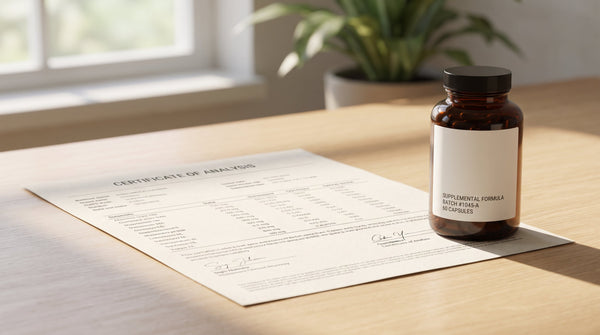
- Batch-level testing you can read. A Certificate of Analysis from an independent lab, tied to the batch in your hand. Our guide to reading a COA works on any brand's report.
- Doses in plain sight. Every ingredient, every amount, no proprietary-blend fog. If you're evaluating products that borrow the GLP-1 class's name, our label-reading guide covers the five-minute version.
- Claims that match the category. A supplement supports normal function; it is not a medication and not a substitute for any prescription treatment. A "research" label on a consumer checkout page is the opposite of this: a category costume.
We hold our own products to that list because it is the list we would use as buyers. PhenAprin XR is manufactured in the USA in a cGMP facility, every batch is third-party tested with the results published on our Certificate of Analysis page, and every dose is printed on the label, including its 800 mg of glucomannan per two-capsule serving, a supportive amount below the 3 g per day used in the European weight-management claim context. Glucomannan carries a standing rule wherever its fullness benefit is mentioned: take each capsule with at least 8 oz of water, never right before bed, and not at all if you have difficulty swallowing.
Provenance, testing, doses, honest claims. The FDA's 2026 paperwork is what happens when all four go missing at once.
These statements have not been evaluated by the Food and Drug Administration. This product is not intended to diagnose, treat, cure, or prevent any disease.
Frequently asked questions
What is FDA Import Alert 66-80?
FDA Import Alert 66-80 is the agency's instruction, updated September 21, 2026, that GLP-1 class bulk drug substances may be detained at the border without physical examination. The FDA issued it after finding 21 percent of 48 evaluated supplier sites out of compliance with manufacturing standards, and the alert publishes a short exemption list of firms whose compliance is demonstrated.
What does detention without physical examination mean?
Detention without physical examination means the FDA can hold a shipment at the border based on the alert alone, without opening and testing that particular shipment. The burden flips to the importer to prove the product meets US requirements before it can enter. It is one of the agency's strongest routine border tools for products with a documented compliance history.
Does a "research use only" label make a peptide legal to buy?
No. A "research use only" label describes laboratory chemicals for institutional research, not consumer products. The FDA's August 2026 warning letter rejected that defense explicitly: when a site's own marketing describes human benefits and dosing, the products are unapproved new drugs under the Federal Food, Drug, and Cosmetic Act, whatever the vial's label says.
Are all imported supplement ingredients unsafe?
No. Import Alert 66-80 applies default detention to one class of drug ingredients and publishes the short list of firms exempted after demonstrating compliance; it is not a judgment on every imported ingredient or any country's whole industry. Global supply chains include well-run, inspected manufacturers everywhere. The practical lesson is narrower: demand visible provenance and batch testing from any product you buy.
How do I check who actually makes a product?
Start with the label: US law requires a supplement to name its manufacturer, packer, or distributor with contact information. Then ask for the batch Certificate of Analysis and the facility standard it was made under. A company that cannot answer those two questions in writing has answered a different question. We publish both for every PhenAprin batch.
References
- U.S. Food and Drug Administration. Import Alert 66-80: Detention Without Physical Examination of Glucagon-Like Peptide-1 (GLP-1) Receptor Agonist Bulk Drug Substances (updated September 21, 2026). [link]
- U.S. Food and Drug Administration. Warning Letter, MARCS-CMS 735063 (August 24, 2026): unapproved new drug charges for weight-loss peptides sold online as research use only. [link]
- U.S. Food and Drug Administration. FDA's Concerns with Unapproved GLP-1 Drugs Used for Weight Loss. [link]
- U.S. Food and Drug Administration. Questions and Answers on Dietary Supplements (label identity requirements). [link]

From PhenAprin
PhenAprinXR Diet Pills
Transparent label, honest dosing, third-party tested.
See the formulaFind your fit
Find the PhenAprin formula that fits your routine
Three formulas, one transparent label. Compare them and choose the one built for your day.